The Story
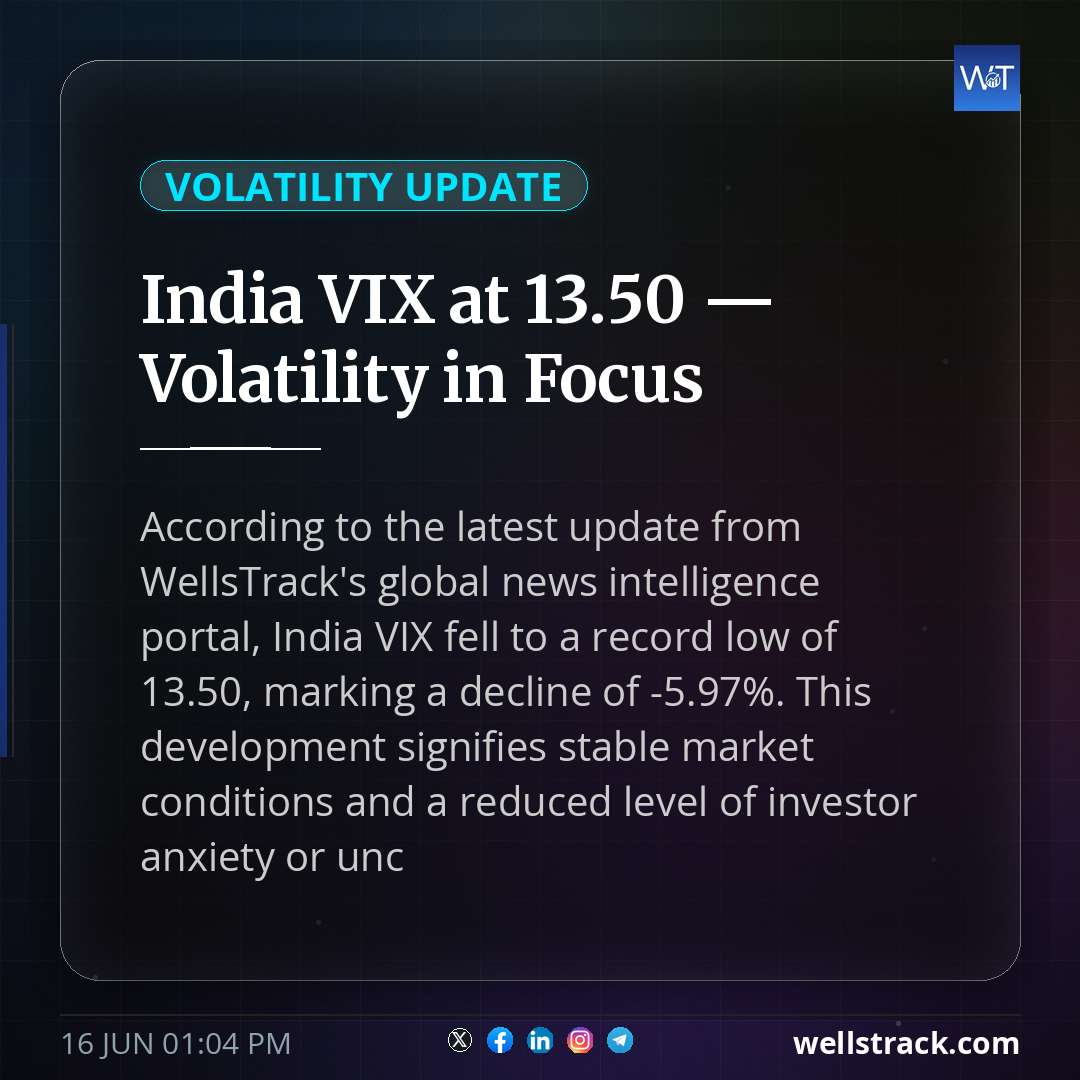
According to the latest update from WellsTrack's global news intelligence portal, India VIX fell to a record low of 13.50, marking a decline of -5.97%. This development signifies stable market conditions and a reduced level of investor anxiety or uncertainty about the future direction of the Indian stock market.
Context & Background
The India VIX, often likened to its American counterpart's VIX, measures volatility in the Indian equity market. At 13.50, this level is considered exceptionally low by historical standards, indicating that investors are currently experiencing an unusually calm and stable state of mind.
Additionally, steps towards financial inclusion and digitalization have also contributed to this climate.
To better understand the significance of this development, it is crucial to examine the broader context of India's economic policies over recent years. Since the implementation of the Goods and Services Tax (GST) in July 2017, India has sought to reduce bureaucracy and corruption within its economy, a move that has led to greater market predictability and stability. Additionally, steps towards financial inclusion and digitalization have also contributed to this climate.
Structurally, these policies have affected various stakeholders including businesses, consumers, and investors. For instance, the GST has streamlined tax procedures for both buyers and sellers, reducing compliance risks and costs. Investors have been quick to recognize that such reforms can lead to more efficient markets with reduced volatility.
The geopolitical landscape also plays a significant role in shaping market conditions. Factors such as regional tensions, global economic shifts, and India's bilateral relations with other major players like the US and China all contribute to fluctuations in the VIX index. Understanding these dynamics is essential for grasping why 13.50 matters not just within Indian financial circles but on a broader global stage.
Global Impact & Ripple Effects
The low level of volatility observed in India's equity market has far-reaching implications. For instance, it could attract foreign investors seeking stable and less-risky markets to invest in. The lower levels of uncertainty may also lead to reduced risk premiums for companies listed on the Indian stock exchange.
However, this stability can be both a blessing and a curse. On one hand, it provides comfort to investors who might be hesitant about investing due to potential market risks. On the other hand, if maintained over an extended period without any clear signs of economic or political instability, such conditions could stifle innovation and growth as companies may become complacent.
Additionally, the stability in India's equity markets can impact neighboring countries and emerging economies, which often look to India for investment signals. For example, a stable Indian market might embolden investors from other developing nations, further stabilizing their own financial landscapes. Conversely, if India's market instability is seen as an indicator of broader global issues, stability there could also serve as reassurance to the rest of the world.
Expert Perspective & Outlook
The current state of India’s VIX index at 13.50 suggests that the Indian stock market is currently in a period of exceptionally low volatility, which could be attributed to various factors including recent economic reforms and geopolitical stability within India.
However, as with any measure of market sentiment, it is important to consider potential scenarios where unexpected events may disrupt this calm. Experts predict there are both positive and potentially negative outcomes depending on how the current stable climate evolves into the future.
"Low VIX levels indicate confidence in the Indian economy’s stability, but they also highlight how much can change with little warning." - Dr. Rajesh Kumar, Economist at WellsTrack
As such, while 13.50 suggests a current climate of stability and predictability within India's stock market, the potential for volatility remains evident. The trajectory of this index will be significantly influenced by future events that may not have been anticipated.