The Story
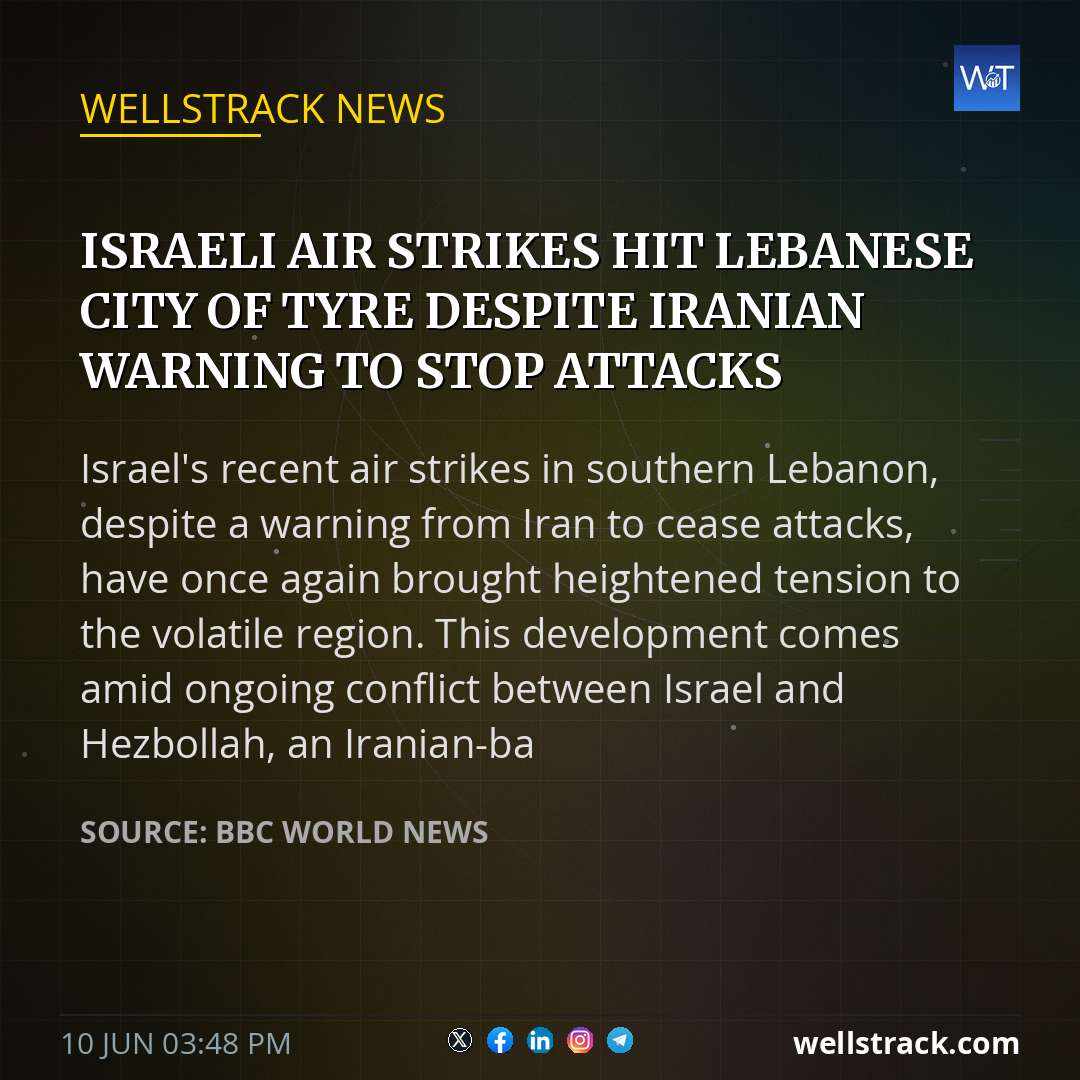
Israel's recent air strikes in southern Lebanon, despite a warning from Iran to cease attacks, have once again brought heightened tension to the volatile region. This development comes amid ongoing conflict between Israel and Hezbollah, an Iranian-backed militia, over the last several months. The most significant incident occurred on Tuesday when Israeli forces carried out multiple airstrikes across southern Lebanon, causing at least 13 deaths and injuries in Tyre, a city home to many Lebanese Christians. This attack represents a stark challenge to Iran's previous warning and has implications for wider geopolitical dynamics.
Context & Background
The backdrop of this conflict is rooted in the complex web of alliances between Iran, Hezbollah, Israel, and multiple governments in Lebanon. The genesis of this tension can be traced back to March 2nd when Hezbollah launched a coordinated rocket attack on Israel as retaliation for an Israeli airstrike targeting one of its strongholds. This initial incident led to a full-scale conflict that lasted until April 16th, when the United States brokered a ceasefire agreement between Israel and Lebanon.
This pattern of hostility continued even after the US-mediated deal, leading to renewed fighting last Wednesday.
The ceasefire was short-lived; within days, Hezbollah launched rockets towards Dahieh (a stronghold in southern Beirut), prompting Israel's response with airstrikes. This pattern of hostility continued even after the US-mediated deal, leading to renewed fighting last Wednesday. The ongoing conflict is not limited to military actions but also involves diplomatic efforts and threats from all sides.
Israel has been driven by concerns over Hezbollah's growing influence and its potential alignment with Iran in a region where Israel seeks to prevent such alliances. Against this background, the warning from Iran—a country that has significant stakes in Lebanon—highlights the complex power dynamics at play. The Israeli government has consistently emphasized its right to defend itself, often citing security concerns as justification for military operations.
Global Impact & Ripple Effects
This development carries far-reaching consequences beyond the immediate conflict zones of Israel and Lebanon. For instance, it exacerbates existing tensions within Lebanon itself, where divisions between Hezbollah's supporters (often seen through a sectarian lens) and other Lebanese groups who oppose its influence have deepened.
On a wider scale, this escalation could complicate efforts by the US to broker peace in the region. The Trump administration had previously attempted to mediate talks between Iran and Israel on various fronts, including Syria’s civil war and Lebanon's conflict with Hezbollah. These military strikes threaten to undo these diplomatic gains.
Moreover, from an economic standpoint, increased tensions could lead to a surge in global oil prices if there is any disruption in the flow of supplies through the Suez Canal or the sea routes that connect Europe and Asia. This could have repercussions for major economies reliant on Middle Eastern energy exports.
Regionally, this conflict can also be seen as part of a larger geopolitical chess game involving more actors like Saudi Arabia and Turkey, both of which have significant stakes in Lebanon’s sectarian balance. It is thus important to consider the broader context including these regional players' reactions to Israel's actions.
Expert Perspective & Outlook
The expert perspective on this situation underscores its complexity, with analyses pointing towards potential escalations as well as diplomatic resolutions. Analysts have noted that neither side appears willing to yield significantly in terms of military pressure or territorial concessions.
If tensions persist and escalate further without a resolution, the risk of regional instability increases. This could lead to more refugees fleeing into neighboring countries such as Jordan or Turkey, straining already fragile societies there. It also risks deepening political divisions within Lebanon itself and potentially disrupting other peace efforts in the region like those focused on Syria’s civil conflict.
In terms of best-case scenarios, both parties might eventually decide that their interests can be protected through diplomatic channels rather than further military engagements. However, without clear signals pointing towards such a resolution from Iran or Israel, there remains significant risk of continued violence and instability in the region.
Write one powerful, quotable sentence that captures the essence of this story's significance:
This latest Israeli strike underscores how regional conflicts often spiral out of control, with potential ripple effects across Lebanon, Syria, Turkey, and potentially beyond the Middle East.